Have you ever typed a question into Google and felt amazed at how quickly you got an answer? Now imagine a search engine that doesn’t just find links—it actually understands your question and gives you a direct, meaningful response. That’s the basic idea behind AI search.
AI search is a smarter way of finding information using artificial intelligence (AI). Instead of simply matching keywords, it tries to understand what you mean, what you’re looking for, and sometimes even why you’re asking. Let’s break it down in a simple, friendly way.
From Keyword Search to Smart Search
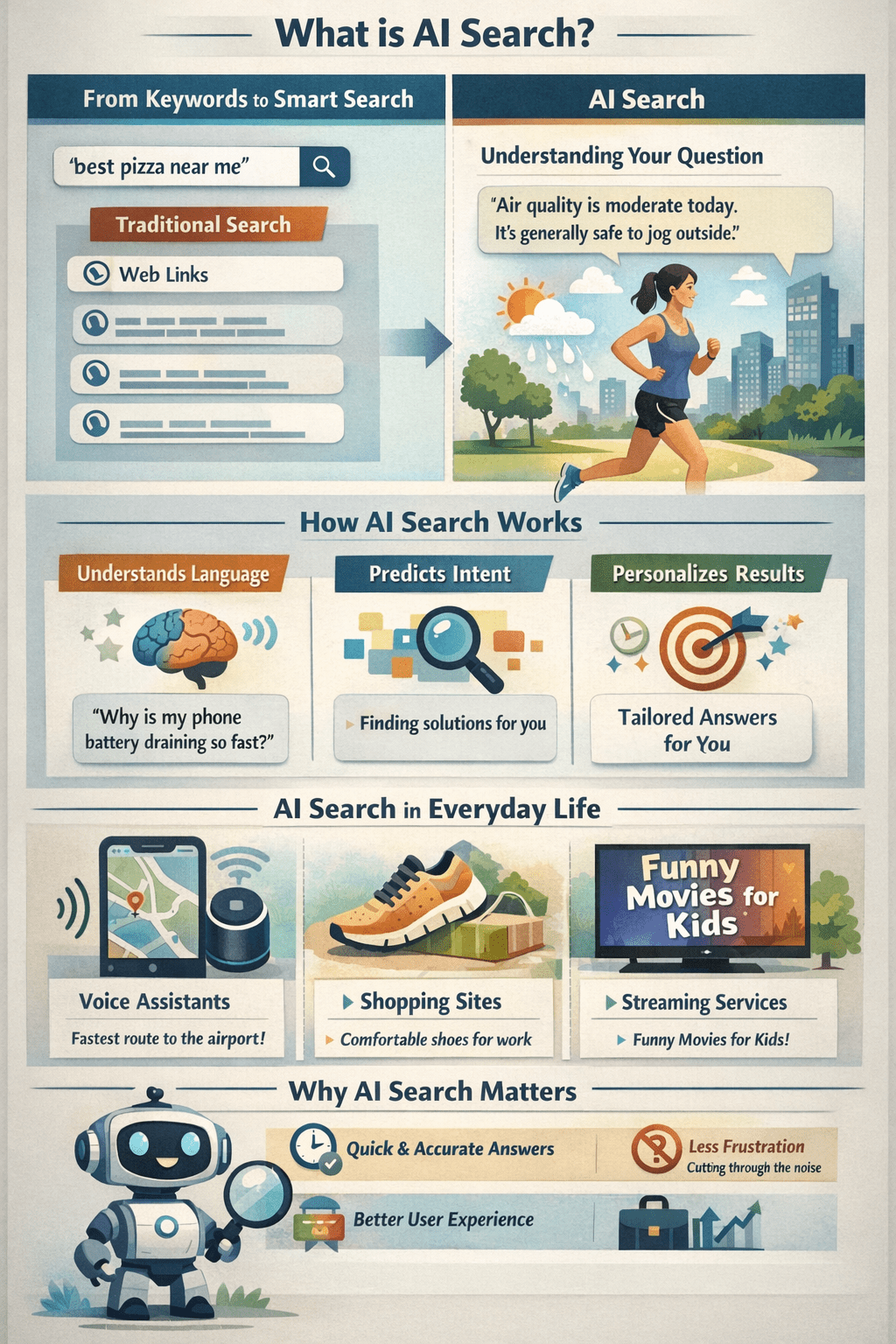
Traditional search engines work mainly by matching keywords. If you type “best pizza near me,” the system scans billions of web pages and looks for those exact words or related ones. It ranks results based on popularity, relevance, and other technical factors.
AI search goes a step further. It uses technologies like natural language processing (which helps computers understand human language) and machine learning (where systems improve by learning from data) to interpret your intent.
For example, if you type:
“Is it safe to jog outside today?”
A traditional search might show you general fitness articles. But an AI-powered search system could check your location, analyze weather and air quality data, and respond with something like: “Air quality is moderate today in your area. It’s generally safe to jog, but sensitive individuals may want to limit prolonged outdoor activity.”
That’s not just finding information—that’s understanding context.
How AI Search Actually Works
At its core, AI search combines several technologies:
First, it understands language. If you ask, “Why is my phone battery draining so fast?” it doesn’t just focus on the words “phone” and “battery.” It understands that you’re experiencing a problem and looking for causes or solutions.
Second, it predicts intent. AI systems analyze patterns from millions of similar searches. If many people who asked the same question later clicked on troubleshooting guides, the system learns that this is probably what you want too.
Third, it personalizes results. If you usually search for tech tutorials, you might see more detailed, technical answers. If you prefer beginner-friendly explanations, the AI may adjust accordingly.
Think of it like the difference between asking a librarian for a book by title versus explaining your research topic and letting the librarian recommend the best resources. AI search acts more like that helpful librarian.
Everyday Examples of AI Search
You may already be using AI search without realizing it.
When you use voice assistants like Siri or Google Assistant and ask, “What’s the fastest way to get to the airport?” the system doesn’t just search for web pages. It calculates traffic, checks routes, and gives you a real-time answer.
Online shopping platforms also use AI search. If you type “comfortable shoes for standing all day,” the system understands you’re looking for supportive footwear, not just any shoes. It may prioritize sneakers with cushioning and strong reviews from nurses or retail workers.
Even streaming platforms use AI search. If you search for “funny movies for kids,” the system interprets age-appropriateness and humor style, not just the word “funny.”
Why AI Search Matters
AI search saves time. Instead of clicking through five different websites, you often get a summarized, direct answer.
It also reduces frustration. Have you ever searched for something very specific—like “how to fix a leaky kitchen faucet without replacing it”—and felt overwhelmed by irrelevant results? AI search aims to cut through that noise.
For businesses, AI search improves customer experience. For students, it makes research faster. For professionals, it helps uncover insights buried deep in massive amounts of data.
But it’s not perfect. AI systems can misunderstand questions or generate incorrect answers. That’s why critical thinking is still essential. AI search is a powerful assistant, not an all-knowing expert.
Key Takeaways
AI search is the evolution of traditional search. Instead of just matching keywords, it understands language, context, and user intent. It learns from patterns, adapts to users, and often provides direct, conversational answers.
If traditional search is like flipping through an index in the back of a book, AI search is like having a knowledgeable guide sitting next to you, explaining things in real time.
As AI technology continues to improve, search will likely become even more intuitive—anticipating needs, integrating voice, visuals, and real-time data, and offering more personalized insights.
The next time you ask your phone a question and get a surprisingly accurate answer, you’ll know what’s happening behind the scenes.
If you’re curious about how technologies like AI are reshaping our digital world, keep exploring and asking questions. The future belongs to those who understand it.
Check out my collection of e-books for deeper insights into these topics: Shafaat Ali on Apple Books.

Leave a comment