Have you ever played a video game where the characters feel surprisingly “real”? Or used a flight simulator that lets pilots practice without ever leaving the ground? Behind many of these experiences is something called AI simulation.
But what exactly does that mean?
Let’s break it down in simple, everyday language.
Understanding the Basics
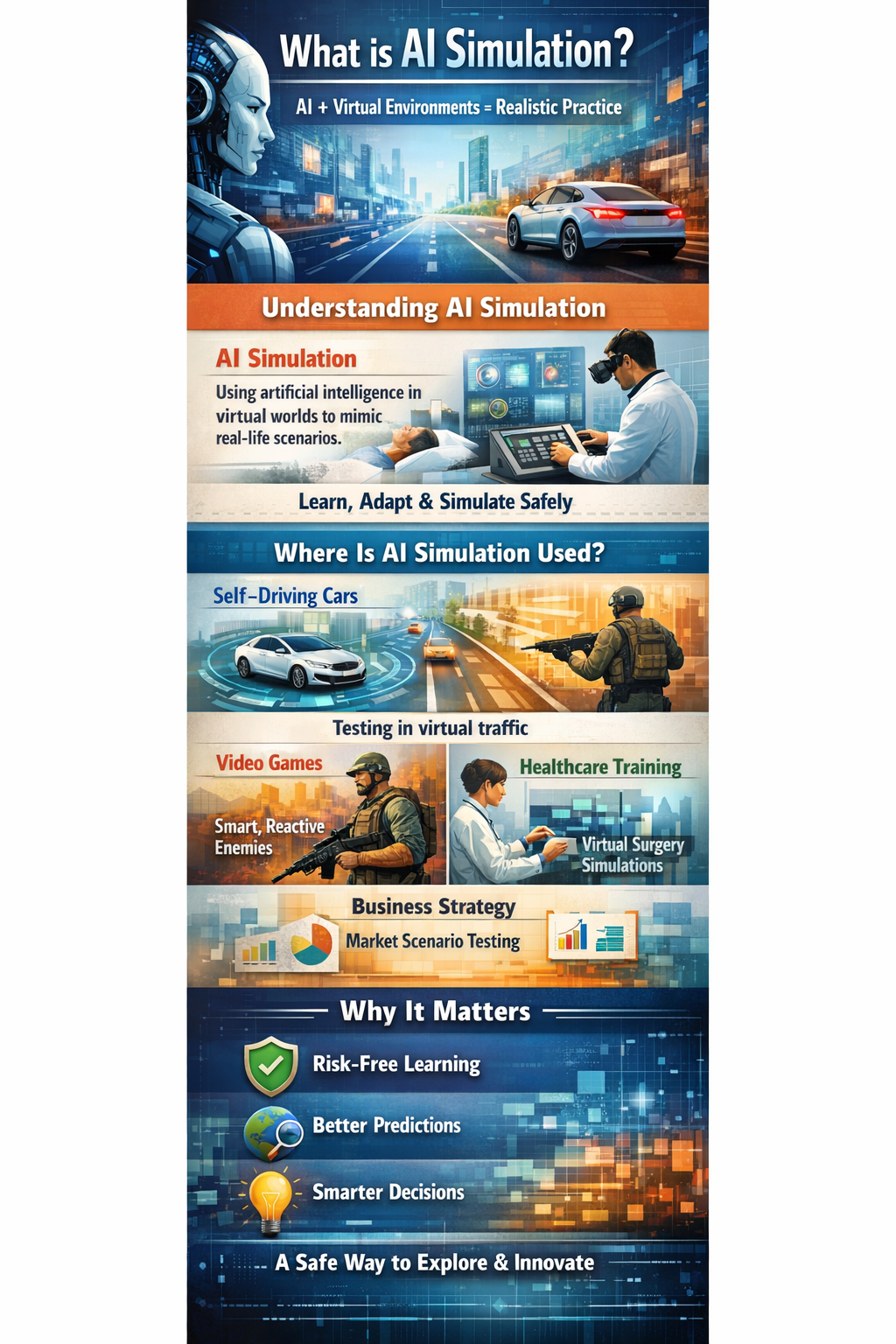
AI simulation is the use of artificial intelligence (AI) inside a simulated, or virtual, environment to imitate real-world situations, behaviors, or systems.
Think of it like this: a simulation is a digital “practice world.” AI is the brain inside that world that makes things act intelligently.
When you combine the two, you get a system that can learn, adapt, and behave in ways that resemble real life.
For example, imagine a driving simulator. The road, traffic lights, and cars are all part of the simulation. But what makes other vehicles change lanes, slow down, or react to you? That’s where AI comes in. It helps those digital drivers make decisions—just like real humans would.
What Is a Simulation, Really?
A simulation is simply a model of a real-world system.
Airlines use flight simulators to train pilots. Medical schools use surgical simulators to train doctors. Even weather apps use simulations to predict storms.
In all these cases, the goal is the same: recreate reality in a safe, controlled environment.
Now, when we add AI into the mix, the simulation becomes smarter. Instead of just following fixed rules, it can learn from data and adjust its behavior.
Where Is AI Simulation Used?
AI simulation is used in more places than you might think.
1. Self-Driving Cars
Companies developing autonomous vehicles don’t just test cars on real roads. They use millions of virtual miles in simulated environments. AI systems “practice” driving in different weather conditions, traffic situations, and emergencies.
This way, the car’s AI learns how to handle rare but dangerous situations—like a pedestrian suddenly crossing the street—without putting anyone at risk.
2. Video Games
Ever noticed how enemies in modern games adapt to your moves? That’s AI simulation at work.
Game developers create digital worlds where AI-controlled characters learn patterns and react dynamically. Instead of doing the same thing every time, they adjust their strategy based on what you do.
It makes the game feel more realistic and exciting.
3. Healthcare and Medicine
In healthcare, AI simulations can model how diseases spread or how a treatment might affect the human body.
For example, during disease outbreaks, researchers use simulations powered by AI to predict how infections might spread across cities. This helps governments plan better responses.
4. Business and Finance
Companies use AI simulations to test business strategies. Imagine launching a new product. Instead of risking millions of dollars, businesses can simulate market conditions to see how customers might respond.
It’s like running a “what-if” experiment before making real-world decisions.
How Does AI Make Simulations Smarter?
Traditional simulations follow fixed rules. If A happens, then B follows. Simple and predictable.
AI changes that.
AI systems can analyze large amounts of data, identify patterns, and make decisions based on probabilities. They can also improve over time through something called machine learning—where the system learns from past experiences.
Let’s use a simple example.
Imagine teaching a child to ride a bicycle. At first, they wobble and fall. But over time, they learn balance through trial and error.
AI in simulations works similarly. It tries different actions, sees what works, and gradually improves. In a simulated world, it can make thousands—or even millions—of mistakes without real-world consequences.
That’s powerful.
Why Is AI Simulation So Important?
AI simulation allows us to test, train, and predict without risk.
You wouldn’t want a beginner pilot’s first flight to be in a real passenger plane. You wouldn’t want a new medical treatment tested blindly on patients. Simulations give us a safe training ground.
As AI continues to grow, simulations are becoming more realistic. They’re helping scientists explore climate change, engineers design smarter cities, and educators create interactive learning tools.
In short, AI simulation is like a digital rehearsal space for the real world.
Key Takeaways
AI simulation combines intelligent decision-making (AI) with virtual environments (simulations). It helps us practice skills, test ideas, and predict outcomes safely and efficiently.
Whether it’s self-driving cars learning the rules of the road, doctors practicing surgery, or businesses testing strategies, AI simulation reduces risk and increases understanding.
As technology advances, these simulations will only become more detailed and more powerful. We’re moving toward a future where digital worlds help us make better real-world choices.
If you’re curious about how emerging technologies are shaping our future, keep exploring and learning.
Check out my collection of e-books for deeper insights into these topics: Shafaat Ali on Apple Books.

Leave a comment