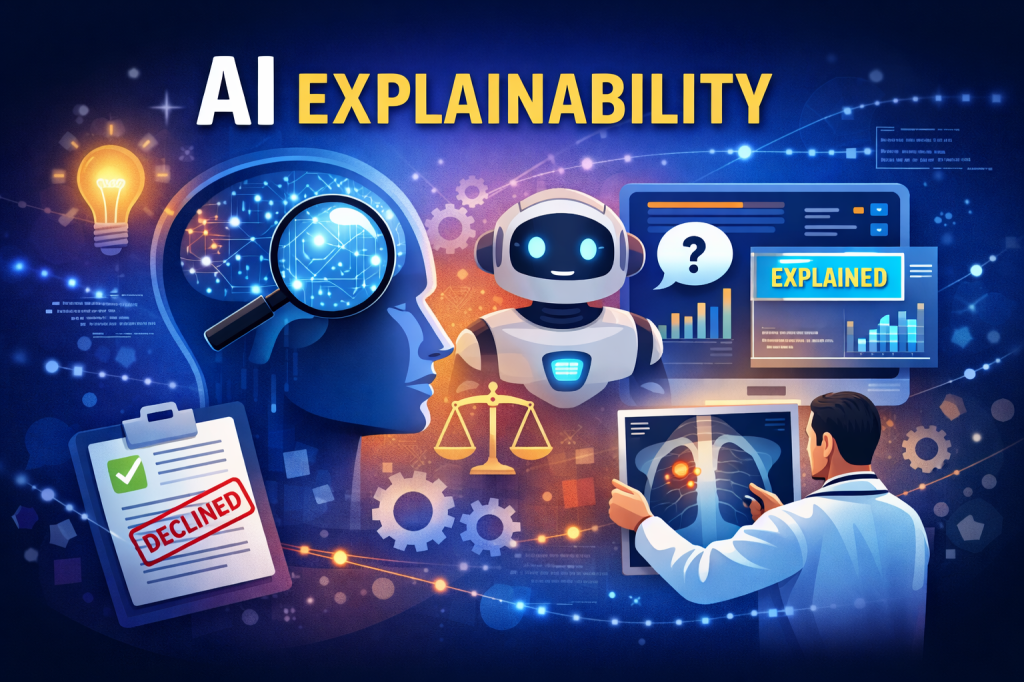
Have you ever used a navigation app that suddenly rerouted you through a strange side street and you wondered, “Why did it choose this way?” Now imagine that same confusion—but in a hospital, a bank, or a courtroom. That’s where AI explainability becomes incredibly important.
AI explainability is all about understanding why an artificial intelligence system made a particular decision. It’s the ability to look inside the “black box” of AI and get a clear, human-friendly explanation of what happened.
Let’s break that down in simple terms.
Why Is AI Sometimes a “Black Box”?
Many modern AI systems, especially those based on machine learning, learn patterns from huge amounts of data. For example, if an AI is trained to detect spam emails, it studies thousands or millions of examples and learns patterns that usually signal “spam.”
The challenge? These systems don’t always explain their reasoning in plain language. Instead, they process data through layers of mathematical calculations. Even the engineers who built the system might not fully understand how it reached a specific decision.
Think of it like baking a cake using a recipe you didn’t write. You know the ingredients and you see the result, but you’re not completely sure how the flavors blended the way they did. AI explainability aims to give you that missing “recipe insight.”
A Real-World Example: Loan Approvals
Imagine you apply for a loan online. An AI system reviews your application and rejects it. Naturally, you’d want to know why.
Was it your credit score? Your income? Your employment history?
Without explainability, the system might simply output: “Application denied.” That’s frustrating and unfair. With explainability, the system might say: “Application denied because your credit utilization rate is above 50% and your income does not meet the minimum threshold.”
That explanation helps you understand the decision and even improve your situation. In industries like banking and healthcare, explainability isn’t just helpful—it’s often legally required.
Another Example: Medical Diagnosis
Now consider a hospital using AI to help detect diseases from X-rays. Suppose the AI predicts that a patient has pneumonia.
Doctors cannot simply accept the result without understanding why. Did the AI detect unusual patterns in the lungs? Was it influenced by something irrelevant, like image brightness?
Explainability tools can highlight which parts of the X-ray influenced the AI’s decision. This builds trust and allows doctors to verify whether the AI is focusing on medically relevant areas.
In high-stakes fields, blind trust is dangerous. Explainability acts like a flashlight inside the machine’s reasoning process.
Why Explainability Matters
There are three big reasons AI explainability is so important:
1. Trust
If people don’t understand AI decisions, they won’t trust them. Transparency builds confidence.
2. Accountability
If an AI makes a harmful decision, someone needs to be responsible. Explainability helps identify what went wrong.
3. Fairness
AI systems can sometimes reflect biases in the data they were trained on. By examining how decisions are made, we can spot unfair patterns and correct them.
Think of explainability like nutrition labels on food. You don’t just want the product—you want to know what’s inside.
Different Levels of Explainability
Not all AI systems are equally mysterious. Some simpler models, like decision trees (which work like flowcharts), are easier to understand. You can literally trace the path of a decision.
More complex systems, like deep neural networks, are harder to interpret. These systems can contain millions of parameters (adjustable values the AI learns). That’s where special explainability techniques come in, helping us approximate and summarize what the system is doing.
In simple terms, explainability doesn’t always mean knowing every detail. Sometimes it means getting a clear summary that humans can understand.
Forward-Looking Insights
As AI becomes more integrated into daily life—recommendation systems, hiring tools, healthcare diagnostics—the demand for explainability is growing rapidly.
Governments and organizations around the world are emphasizing responsible AI development. Future AI systems are likely to be designed with explainability built in from the start, rather than added as an afterthought.
Imagine a world where every AI decision comes with a clear explanation, just like a teacher showing their steps in solving a math problem. That’s the direction we’re heading.
Key Takeaways
AI explainability is about making artificial intelligence decisions understandable to humans. It helps build trust, ensures fairness, and supports accountability. Whether it’s a loan application, a medical diagnosis, or even your social media feed, knowing why something happened empowers you.
As AI continues to shape our world, understanding its reasoning won’t just be a technical concern—it will be a social necessity.
Check out my collection of e-books for deeper insights into these topics: Shafaat Ali on Apple Books.

Leave a comment