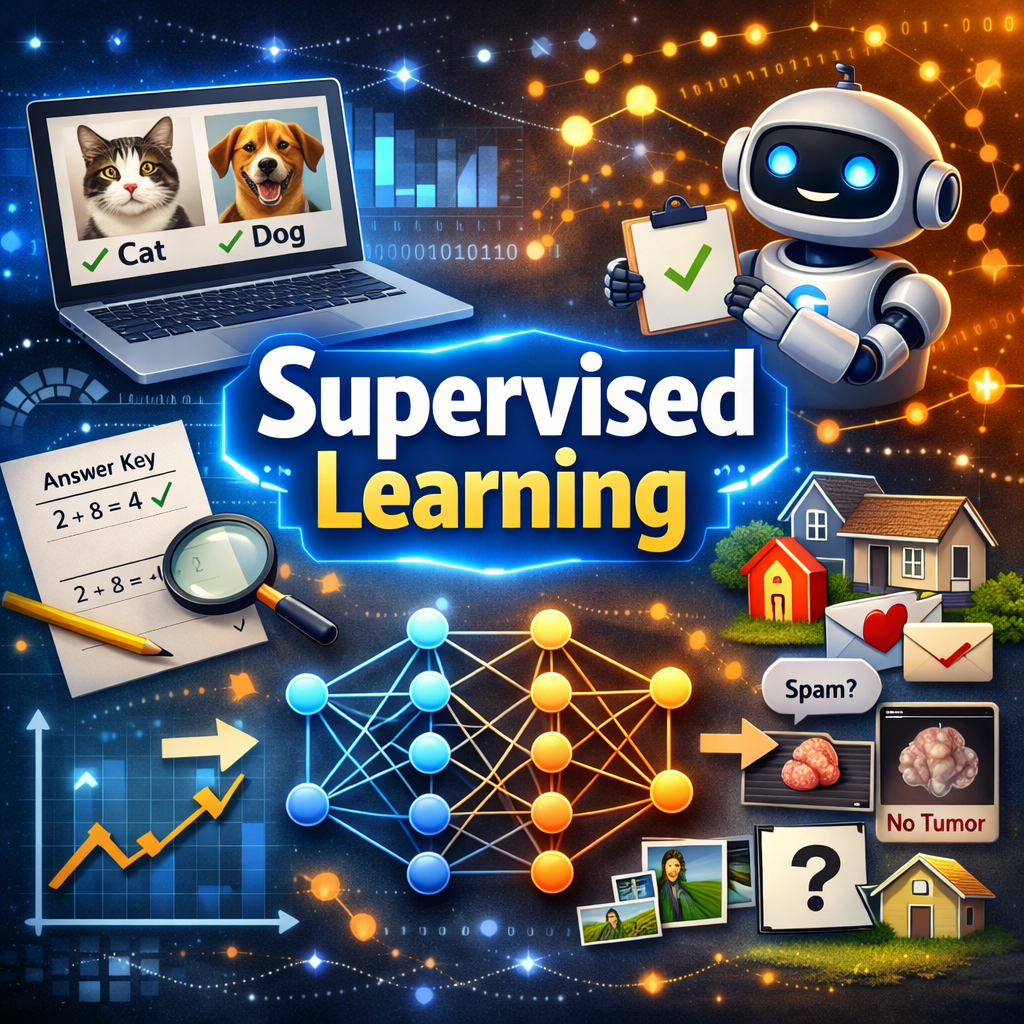
Have you ever taught a child how to recognize animals? You might point to a picture and say, “This is a cat,” and then another picture: “This is a dog.” After enough examples, the child starts recognizing cats and dogs on their own.
That simple teaching process is a lot like supervised learning in artificial intelligence.
Supervised learning is a type of machine learning where a computer is trained using labeled data. “Labeled” simply means the correct answers are already provided. The machine studies these examples and learns how to make predictions about new, unseen data.
Let’s break that down in a friendly, practical way.
Learning with an Answer Key
Imagine you’re studying for a math test with a workbook that includes the answers at the back. You solve a problem, check the answer, and adjust if you’re wrong. Over time, you get better because you’re learning from feedback.
That’s supervised learning in action.
In technical terms, the data used to train the model includes:
- Input (the question or problem)
- Output (the correct answer)
For example:
- Input: A photo of an email
- Output: “Spam” or “Not Spam”
By feeding thousands of labeled examples into the system, the model learns patterns. It starts noticing which types of words, phrases, or structures are common in spam emails. Then, when a new email appears, it can make a smart guess.
Two Main Types of Supervised Learning
Supervised learning usually falls into two big categories: classification and regression.
Classification: Sorting Into Buckets
Classification is about putting things into categories.
Think of a fruit-sorting machine in a factory. It looks at shape, size, and color, and decides: “Apple,” “Orange,” or “Banana.”
In real life, supervised classification is used in:
- Email spam detection
- Medical diagnosis (disease or no disease)
- Face recognition systems
For instance, when a hospital uses AI to detect tumors from medical images, the system has been trained on thousands of labeled images: “tumor” and “no tumor.” Over time, it learns the visual differences.
Regression: Predicting a Number
Regression is about predicting a continuous value — usually a number.
Imagine you’re trying to estimate house prices. You look at:
- Size of the house
- Location
- Number of bedrooms
Using past labeled data (houses and their selling prices), the model learns patterns. Then it can estimate the price of a new house.
It’s similar to how an experienced real estate agent makes price predictions after seeing many properties over the years.
How Does the Learning Actually Happen?
At its core, supervised learning is about finding patterns.
The computer uses algorithms (step-by-step mathematical procedures) to:
- Look at the input data
- Compare its predictions to the correct answers
- Adjust itself to reduce mistakes
This adjustment process is often called “training.” The model keeps tweaking its internal settings until its predictions become more accurate.
You can think of it like practicing basketball free throws. At first, you miss a lot. But each time you adjust your aim based on feedback, you improve.
Why Is It So Popular?
Supervised learning is widely used because it’s practical and powerful. If you have enough labeled data, it can perform incredibly well.
You see it in:
- Voice assistants understanding speech
- Recommendation systems suggesting products
- Fraud detection in banking
- Self-driving cars recognizing road signs
The key advantage? It learns from real examples with known answers, which makes it more reliable for many real-world tasks.
What’s the Catch?
There is one major requirement: labeled data.
Labeling data can be time-consuming and expensive. Imagine manually tagging millions of images or reviewing thousands of documents. That’s not always easy.
Also, a model is only as good as the data it learns from. If the training data is biased or incomplete, the model’s predictions will reflect that.
So while supervised learning is powerful, it’s not magical. It depends heavily on quality input.
Key Takeaways
Supervised learning is like learning with a teacher and an answer sheet. The model studies labeled examples, finds patterns, and uses those patterns to make predictions about new data.
It powers many everyday technologies — from spam filters to price predictions — and works best when it has large amounts of accurate, labeled information.
If you remember one thing, let it be this: supervised learning is about learning from examples where the right answers are already known.
And just like humans, the more good examples it sees, the smarter it becomes.
If you’re curious about how supervised learning compares to other types like unsupervised or reinforcement learning, that’s where things get even more exciting.
Check out my collection of e-books for deeper insights into these topics: Shafaat Ali on Apple Books.

Leave a comment