Have you ever chatted with someone online and wondered, “Wait… am I talking to a real person?” If yes, you’ve already brushed up against the idea behind the Turing Test.
The Turing Test is a simple but powerful way to ask a big question: Can a machine think like a human? Or more precisely, can it behave in a way that is indistinguishable from a human?
Let’s unpack that in a friendly, no-robot-jargon way.
The Big Idea Behind the Turing Test
The Turing Test was proposed in 1950 by British mathematician and computer scientist Alan Turing. Instead of arguing endlessly about what “thinking” really means, Turing suggested something practical.
He said: Don’t ask if machines can think. Ask if machines can imitate human conversation well enough to fool someone.
That’s it. That’s the core idea.
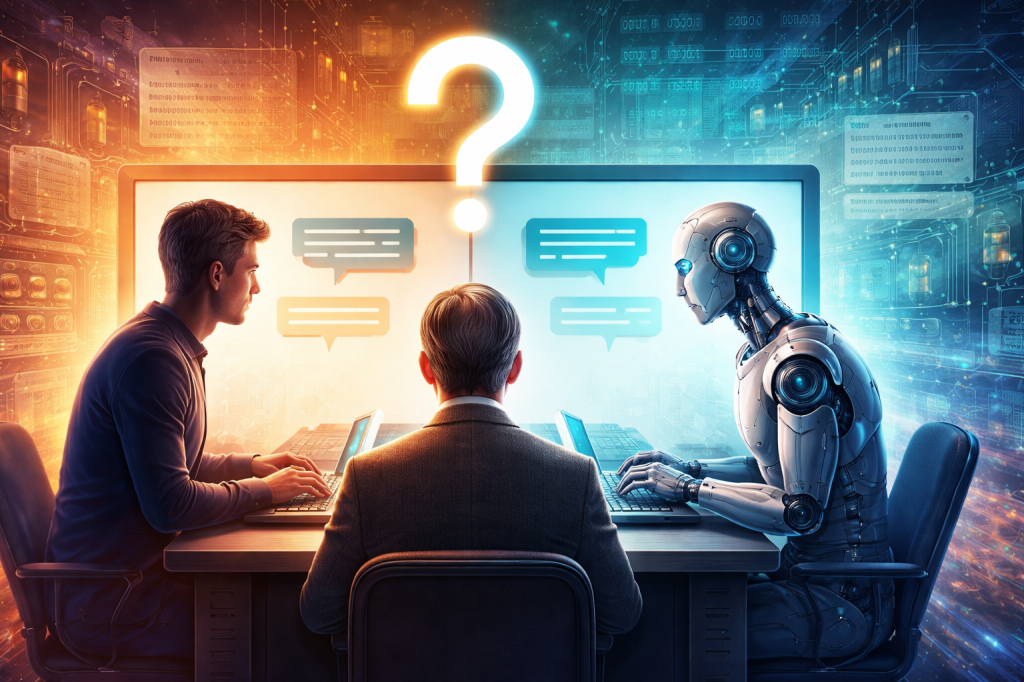
He described something called the “Imitation Game.” Here’s how it works.
There are three participants:
- A human judge
- A human participant
- A machine
The judge communicates with both the human and the machine through text only. No voices. No faces. Just typed conversation. After asking questions and receiving answers, the judge has to decide which one is the human.
If the machine can consistently trick the judge into believing it’s human, it passes the Turing Test.
Simple in design. Huge in implications.
A Real-World Example
Imagine you’re texting two people at the same time. One is your friend. The other is a highly advanced chatbot. You ask both:
“What did you do last weekend?”
Your friend replies:
“I went hiking and nearly slipped into a muddy creek. It was embarrassing but kind of fun.”
The chatbot replies:
“I enjoyed a recreational outdoor walking experience and encountered a water-adjacent soil instability event.”
You’d probably spot the robot instantly, right?
But what if the chatbot said:
“I tried cooking a new pasta recipe and accidentally added too much salt. Lesson learned.”
Now it’s harder to tell.
That’s the challenge. The machine doesn’t need real experiences. It just needs to generate responses that feel human.
Why the Turing Test Was So Revolutionary
Back in 1950, computers were gigantic machines that filled entire rooms. The idea that they could one day have conversations like humans sounded almost like science fiction.
Turing shifted the debate from philosophy to behavior. Instead of asking, “Do machines have consciousness?” he asked, “Can they convincingly act human?”
That shift laid the foundation for the field of artificial intelligence (AI), which focuses on building systems that can perform tasks that normally require human intelligence—like language, problem-solving, and pattern recognition.
In a way, every modern chatbot is part of Turing’s long-running experiment.
Does Passing the Turing Test Mean a Machine Is Conscious?
Here’s where things get interesting.
Passing the Turing Test does not prove a machine is conscious. It only shows that it can simulate human-like conversation.
Think about a magician. When a magician pulls a coin from behind your ear, you know it’s a trick. The illusion looks real, but that doesn’t mean magic powers are involved.
Similarly, a machine might appear intelligent without actually understanding anything. It could be processing patterns and probabilities rather than having thoughts or feelings.
So the Turing Test measures performance, not inner experience.
Criticisms and Modern Debates
Over time, many researchers have pointed out limitations.
For example, a machine could “win” by pretending to be a child or a non-native speaker, explaining away mistakes as language limitations rather than lack of intelligence.
Another issue is that intelligence is much broader than conversation. A system might be amazing at math or visual recognition but poor at small talk. Would it fail the Turing Test even though it’s highly capable?
It’s a bit like judging a brilliant scientist solely on their ability to tell jokes at a dinner party.
That’s why today, the Turing Test is seen more as a historical milestone than a final exam for AI.
Key Takeaways
The Turing Test is not about robots having emotions or self-awareness. It’s about whether a machine can imitate human conversation convincingly enough to fool a human judge.
It was introduced by Alan Turing in 1950 as a practical way to explore machine intelligence.
It sparked decades of research in artificial intelligence and continues to shape discussions about what it means to “think.”
Most importantly, it reminds us that intelligence can be judged by behavior—but behavior alone doesn’t tell the whole story.
As AI systems become more advanced, the line between human-like response and genuine understanding becomes blurrier. The Turing Test still challenges us to think carefully about what intelligence really is—and whether imitation is enough.
If this topic sparked your curiosity, you might enjoy exploring it more deeply. Check out my collection of e-books for deeper insights into these topics: Shafaat Ali on Apple Books.

Leave a comment