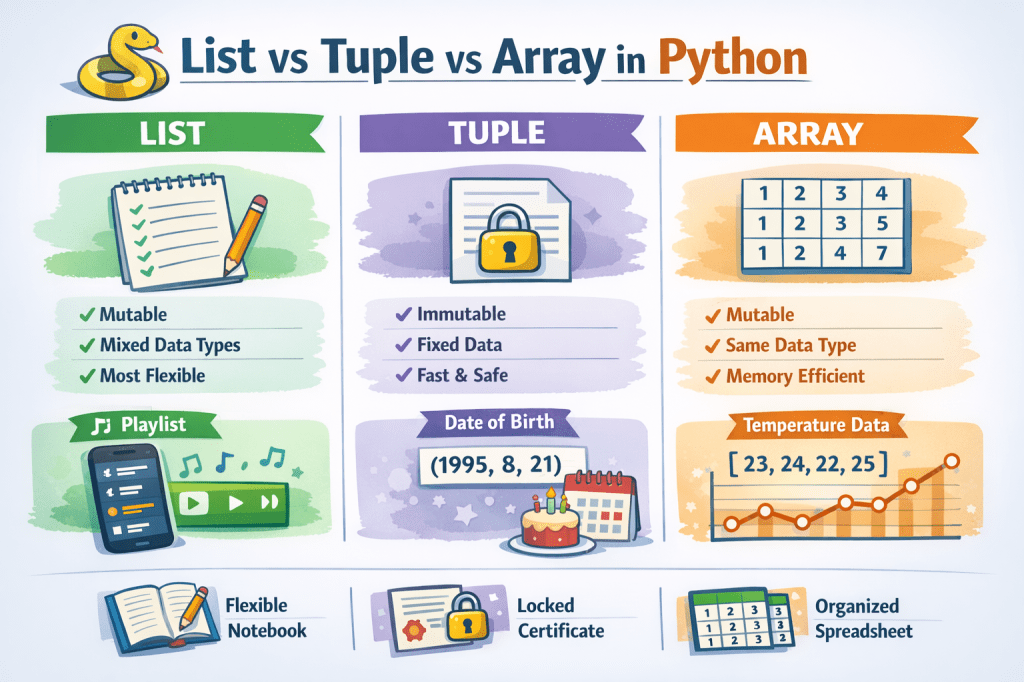
If you’re learning Python, you’ve probably come across lists, tuples, and arrays and wondered, “Aren’t they all just collections of things?” Great question. On the surface, they do look similar. But under the hood, they behave quite differently—and knowing those differences can save you a lot of confusion (and bugs).
Let’s break it down in a simple, practical way.
First, What Is a List?
A list in Python is like a shopping cart. You can put items in, remove items, replace them, and rearrange them whenever you like.
Example:
fruits = ["apple", "banana", "cherry"]You can:
- Add an item →
fruits.append("orange") - Remove an item →
fruits.remove("banana") - Change an item →
fruits[0] = "grape"
Lists are mutable, which means you can change them after creating them.
They can also hold different data types:
my_list = [1, "hello", 3.14, True]That flexibility makes lists the most commonly used data structure in Python.
Real-world example:
Think of a playlist on your phone. You can add songs, delete songs, and rearrange them. That’s a list.
Now, What Is a Tuple?
A tuple is similar to a list—but with one major difference.
Tuples are immutable. Once you create them, you cannot change them.
Example:
coordinates = (10, 20)You cannot do this:
coordinates[0] = 15 # This will cause an errorWhy use tuples if they’re less flexible?
Because sometimes you want data to stay fixed.
Real-world example:
Think of your date of birth. It doesn’t change. If you store it as:
dob = (1995, 8, 21)You don’t want someone accidentally modifying it. Tuples protect your data from unintended changes.
Another benefit: tuples are slightly faster than lists because Python doesn’t have to worry about modifying them.
So in short:
- Lists = flexible
- Tuples = fixed and safe
What About Arrays?
Here’s where it gets interesting.
Python doesn’t use built-in arrays the way some other languages (like C or Java) do. Instead, Python provides:
- The
arraymodule - The powerful
NumPylibrary (used heavily in data science)
An array is more strict than a list.
Example using Python’s built-in array module:
import arraynumbers = array.array('i', [1, 2, 3, 4])Notice the 'i'? That means all elements must be integers.
Unlike lists, arrays:
- Store only one data type
- Are more memory-efficient
- Are faster for numerical operations
Real-world example:
Imagine you’re storing temperatures recorded every hour. They’re all numbers. Using a list works—but an array is more efficient because everything is the same type.
Now, if you step into data science, you’ll likely use NumPy arrays, which are even more powerful for mathematical operations.
Let’s Compare Them Side-by-Side
Here’s the simple difference:
- List
- Mutable
- Can store mixed data types
- Most flexible
- Most commonly used
- Tuple
- Immutable
- Can store mixed data types
- Slightly faster than lists
- Good for fixed data
- Array
- Mutable
- Stores only one data type
- More memory-efficient
- Better for numerical data
When Should You Use Each One?
Use a list when:
- You need to change the data frequently
- You’re working with mixed types
- You’re just doing general programming
Use a tuple when:
- The data should not change
- You want to prevent accidental modification
- You’re returning multiple values from a function
Use an array when:
- You’re working with lots of numbers
- Memory efficiency matters
- You’re doing mathematical calculations
Key Takeaways
Think of it like this:
- A list is a flexible notebook—you can erase and rewrite.
- A tuple is a printed certificate—you can read it, but not edit it.
- An array is a spreadsheet column—organized, efficient, and type-specific.
When you’re just starting out, you’ll mostly use lists. As your programs grow more complex—especially in data analysis—you’ll appreciate arrays more. And tuples? They’re your go-to when stability matters.
Understanding these differences isn’t just about passing exams—it’s about writing cleaner, smarter Python code.
Check out my collection of e-books for deeper insights into these topics: Shafaat Ali on Apple Books.

Leave a comment